
Concrete vibrating is a process that is used to remove air bubbles and excess water from freshly poured concrete. This is done in order to produce a high-quality finished product that is free of defects. Concrete vibrating is a process that should be done as soon as possible after the concrete has been poured in order to achieve the best results.
You may have many quetions about concrete vibrating.
In this guide, I will answer all your doubts based on experience, include:
- Is it necessary to vibrate concrete
- How to vibrate concrete (Include 5 tips to make it stronger and more compact)
- What equipment (tool) is best for concrete vibration?
- And Lots more
Let’s get started.

Is It Necessary to Vibrate Concrete
Most concrete slabs and structural components need to be vibrated except for self-compacting concrete.
But sometimes, you can achieve the same effect as vibrated concrete through specific techniques and tools. For small-area concrete pouring, you may do vibrating concrete by hand. With a hand screed or concrete hammer, tap the surface repeatedly, eliminating air bubbles in the concrete. Another situation is when using a roller screed during construction. The machine compresses the concrete by rolling its roller tube, removing air, and squeezing excess water to the surface. Generally, roller screed can be used when the concrete slump exceeds 3 inches.

How to Vibrate Concrete?
The best concrete vibrating technique with an internal vibrator is to withdraw the vibrator very slowly, at a rate of around 1 inch per second. As long as bubbles still emerge as the concrete vibrator is withdrawn, more vibration is necessary.
Below, we summarize the process of concrete vibration, focusing on mastering the timing of inserting the internal vibrator into the concrete and the speed of removing it. Finally, you will also need to learn how to determine whether the concrete has reached a dense state.
Concrete Vibration Process:
- Before vibrating the concrete, check its consistency to ensure that the mixture is neither too dry nor too wet.
- Slowly insert the internal vibrator into the freshly poured concrete, avoiding any forceful insertion; allow it to sink under its own weight.
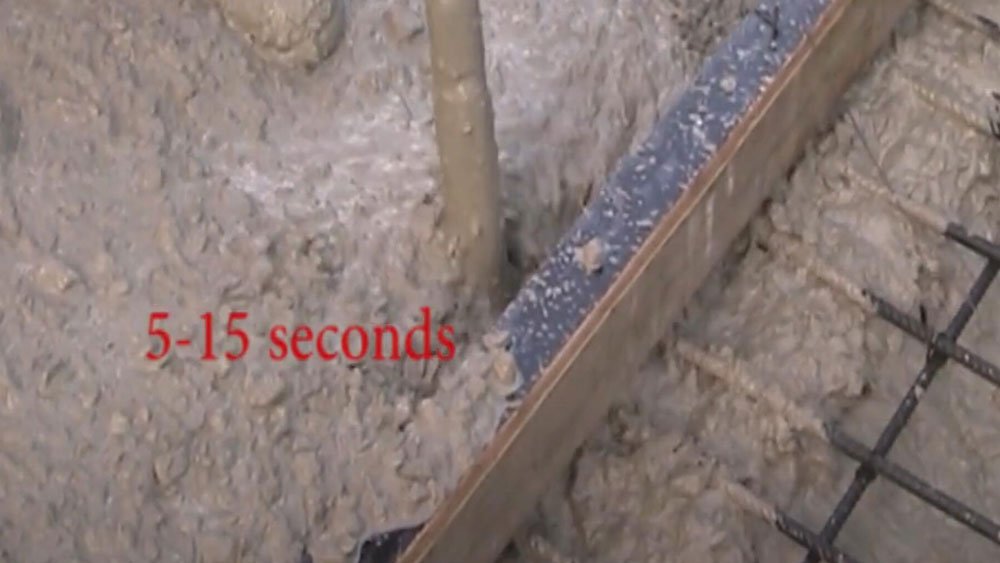
- Keep the vibrator in the concrete for 5 to 15 seconds, depending on when the bubbles stop rising.
Removing the Concrete Vibrator:
The vibrator should be removed slowly at a speed of 100 millimeters per second and then repositioned 500 millimeters from the original location.
Checking the Density of the Concrete Vibrating:
If a film appears on the surface and all bubbles have stopped rising, it indicates that the concrete has been well compacted.
Be careful to avoid two common mistakes: insufficient vibration leading to exposed aggregates, or excessive vibration causing the aggregates to sink (same as balow image). With proper vibration, concrete will achieve its maximum strength and longevity, making it a truly reliable building material. But please make sure that you do not over-vibrate the concrete. This can cause the concrete to settle unevenly and can create voids in the finished product. It is also important to vibrate concrete evenly. This will ensure that the finished product is strong and free of defects.

Based on our experience, we have also summarized 5 tips for vibrating concrete stronger and more compact:
- Make sure that the area you are vibrating has not already been vibrated by another worker.
- Submerge the vibrator head fully into the concrete and hold it there for 5-15 seconds.
- Don’t turn on the vibrator until the tip is fully submerged.
- Pull up the vibrator at an average rate of no more than 3 inches per second.
- Overlap the previous radius of vibration every time you insert the vibrator. A good rule of thumb is that the radius of action is four times the vibrator tip diameter.
When vibrating concrete, you should be fully aware about the features of that concrete being used. By following these simple guidelines, you can ensure that your concrete sets properly.
What Type Concrete Vibrating Tools You Need?
The concrete vibrating process is simple and easy to do, and it can be done with the help of some vibrating tools. These tools will create vibrations that will help to remove any air bubbles or water that is present in the concrete.
Concrete Surface Vibrating
Concrete surface vibrating is a common method used to screeding concrete slab surfaces. It has the advantage of being relatively easy to control, making it a good choice for projects where precision is key. The most commonly used device is the vibrating concrete screed.
Vibrating screeds are tools used to smooth concrete and vibrating concrete after it has been poured. It is a long, flat board that is attached to a vibrating motor. The vibration of the motor helps to remove air bubbles and excess water from the concrete, resulting in a smoother finish.
There are many benefits to using a concrete vibrating screed on your concrete project. Smoother concrete is easier to work with and results in a better finished product. In addition, vibrating the concrete helps to compact it, which can increase its strength.
Internal Concrete Vibrators
Internal concrete vibrators are the most common type used. Many can be handled by a single operator. The process is relatively simple: The worker quickly jams a probe-like internal vibrator down into the wet concrete, then slowly withdraws it. As the vibrator is withdrawn, it creates a series of vibrations that help to settle the concrete and remove any air pockets. This process is essential for creating a strong, durable concrete structure.
Internal vibrators are available in a variety of sizes and configurations, making them ideal for use in a wide range of applications. For example, handheld models are perfect for small jobs, while larger, truck-mounted units are ideal for large-scale projects. No matter what the job entails, there is an internal concrete vibrator that can get the job done quickly and efficiently.

Portable concrete vibrator
Concrete vibrators come in a variety of shapes and sizes, but all serve the same purpose: To remove air bubbles and excess water from freshly poured concrete. Concrete vibrators can be powered by electricity or gasoline, and come in either handheld or inline varieties.
When using a concrete vibrator, be sure to pour the concrete evenly, so that it can vibrate evenly. It’s also important to use a vibrator with the right frequency and amplitude for the job. For example, a lower-frequency vibrator is better suited for larger projects, like parking garages or warehouses.
Vibrating Concrete Formwork
Concrete vibrating motor is a common term for the vibration of concrete formwork. Concrete formwork is a process that is commonly used in precast concrete construction. It involves mounting the vibrators to the outsides of the concrete forms. This process helps to compact the concrete and remove any air pockets that might be present. For larger pours, the external form vibrators are often spaced 6 feet apart. This spacing helps to ensure that the concrete is evenly compacted. Formwork vibration is an important step in creating high-quality precast concrete products. It helps to create a strong product that will be durable and long-lasting.
Conclusion
Concrete vibrating is an important step in the concrete pouring process. It helps to remove air bubbles and excess water, which can create defects in the finished product. Concrete vibrating should be done as soon as possible after the concrete has been poured, in order to achieve a strong and compact concrete.